
✦ Ozone odor removal · Triangle NC ✦
Destroy the odor. Don't mask it.
Air fresheners hide a smell for an afternoon. Ozone shock treatment oxidizes the odor molecule itself and ruptures the bacteria producing it — smoke, pet urine, mildew, cooking odor — down to the cell.
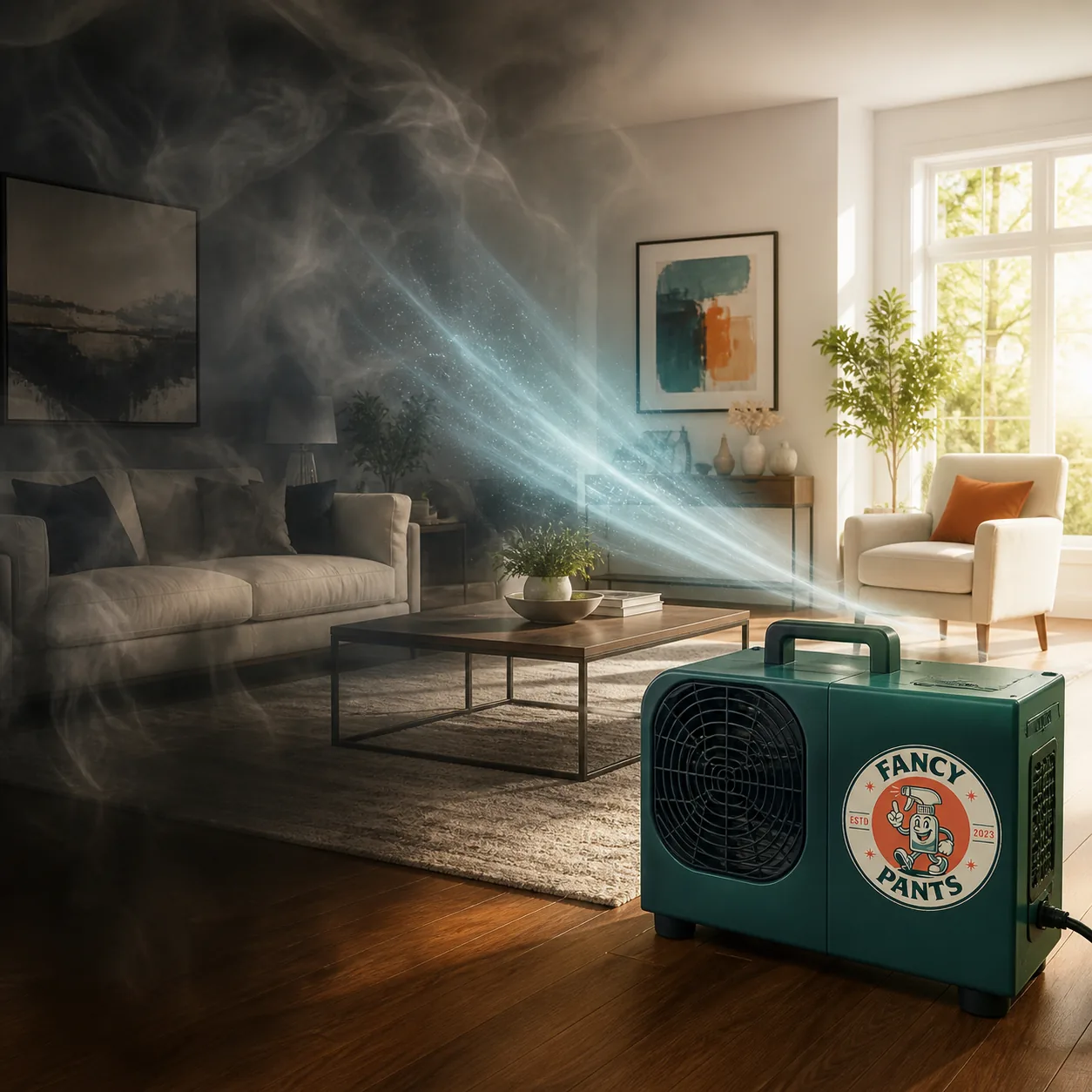
The science, plainly
What ozone actually does.
Ordinary air is O₂ — two oxygen atoms bonded together. Ozone is O₃: a third oxygen atom hanging on loosely, and desperate to leave. When an ozone molecule bumps into a smoke particle, a urine compound, a grease molecule or a mold spore, that third atom tears off and bonds to it. That reaction is oxidation, and it physically breaks the chemical bonds that make the substance smell.
With bacteria and mildew it goes further. Ozone oxidizes the fats and proteins in the organism's cell wall until the membrane fails and ruptures — cell lysis — and the organism dies. It's a structural kill, not a chemical one, which is why microbes don't build tolerance to it the way they do to some disinfectants.
And because it's a gas, it goes where liquids can't: into carpet fiber, upholstery foam, drywall, insulation, closets, cabinet interiors and HVAC ducting. When the job is over, the leftover ozone reverts to plain oxygen. No residue, no perfume, no film.
✦ How we run a treatment
Four stages, one full day.
Ozone is the finisher, not the whole job. Source removal comes first, saturation second, ventilation third, and a smell-test before we hand your keys back.
Source removal first
Ozone is not a substitute for cleaning. Before a single machine runs, we remove the source — trash, soiled textiles, urine-saturated padding, soot film, grease build-up — and hard-clean the surfaces holding the smell. Treating a dirty house with ozone just gasses a dirty house.
Seal & prep the space
We shut down HVAC or set it to circulate depending on the job, close exterior windows, remove plants and any live animals, and post the property. Rubber, latex and some artwork are protected or pulled out of the treatment zone.
Ozone shock treatment
Commercial ozone generators saturate the space with O₃ and hold it there. Run time is set by the severity of the odor and the cubic footage — light odors can be a few hours, heavy smoke or urine jobs run far longer and sometimes need a second pass.
Air out & verify
The generators shut off and the property is ventilated and allowed to decay back to normal air. We re-enter, smell-test room by room, and re-treat any area that still carries the odor before we hand the keys back.
Timing & vacancy
Plan to be out for the day.
This is a full-day service. How long the generators run is set by how bad the odor is and how much air volume we're treating — a single smoky bedroom is a different job from a whole three-story house after a kitchen fire. After the machines shut off, the property still has to be ventilated and given time for the ozone to decay back into ordinary oxygen.
The hard floor is four hours vacant, and that's only for the lightest treatments. In practice, we schedule odor jobs assuming you'll be out of the house for the day and back to a home that smells like nothing at all.
Safety, straight up: at treatment concentrations ozone irritates the lungs, throat and eyes, and can aggravate asthma. Nobody — no people, no pets, no plants — stays in the property while it runs, and we never release a home before it's aired out and verified.
Before we arrive
- The home must be completely vacant — no people, no pets, no plants
- Plan on being out of the property for a full day
- Minimum four hours vacant even on the lightest treatments
- Fish tanks, reptiles and birds must be relocated
- Tell us about anyone with asthma or respiratory conditions
- Leave interior doors, closets and cabinets open for us
What not to do
- Do not re-enter while the machines are running — ozone is a lung irritant
- Don't skip the airing-out window to save time
- Don't expect ozone to fix odor coming from an active leak or dead animal
- Don't run consumer ozone gadgets in an occupied room
- Don't leave rubber items, houseplants or artwork in the zone
- Don't book ozone instead of a deep clean — it works with one, not instead of one
✦ What we treat
Smells we take personally.
If it's organic, embedded or airborne, ozone reaches it. If it's an active leak or a live source, we fix the source first.
✦ Pairs with
Book it alongside the clean.
Add to
Deep Restorative Clean
The right pairing for odor work — we strip the source out with a full deep clean, then shock what soaked into the structure.
See deep cleanAdd to
Move-in / Move-out
The perfect window for ozone: the property is already empty, and our overnight crews can treat and air it out before handover.
See move cleanAdd to
Cleaning for pet owners
Dander, accidents and wet-dog smell handled at the source, then finished with an ozone treatment while the pets are out.
See pet cleaning✦ Common questions
Before you book.
How does ozone actually remove odor?
Ozone (O₃) is oxygen with a third, loosely bound oxygen atom. That third atom wants to break away, and when it does it grabs onto whatever it touches — this is oxidation. Odor is not a smell floating in the air; it's actual molecules of smoke, urine, grease or decay. When ozone collides with those molecules it oxidizes them, breaking the chemical bonds that make them smell. What's left is mostly carbon dioxide, water and plain oxygen. The odor isn't covered up or perfumed over — the molecule that produced it no longer exists.
How does it kill odor at the cell?
A large share of household odor is biological — bacteria, mold and mildew colonies feeding on organic residue. Ozone attacks those organisms at the cell wall. It oxidizes the lipids and proteins that make up the membrane until the wall ruptures — a process called cell lysis — and the cell's contents spill out and the organism dies. Because it destroys the membrane physically rather than interfering with a metabolic pathway, organisms can't build resistance to it the way they can to some chemicals. Unlike a liquid disinfectant, ozone is a gas, so it reaches into fabric, insulation, subfloor, ductwork and wall cavities that a spray bottle never touches — and it leaves no chemical residue behind.
How long does the treatment take?
Plan on a full day. The generators themselves run for a variable window — the worse the odor and the bigger the space, the longer the machines stay on — and then the property has to sit and air out afterward. At absolute minimum the home must be vacant for four hours, but the realistic answer for most homes is that you should plan to be out for the day.
Why does the house have to be empty?
At treatment concentrations ozone is harmful to breathe. It irritates the lungs, throat and eyes and can aggravate asthma. That's exactly why it works so well on odor — it's a powerful oxidizer, and lung tissue oxidizes as readily as a smoke molecule does. So no people, no pets, no plants in the property while the machines run, and the space gets fully ventilated before anyone goes back in.
Is it safe after you leave?
Yes. Ozone is unstable by nature — that's the whole point of it. It naturally reverts back to ordinary oxygen (O₂) over a period of hours, and we accelerate that with forced ventilation before we release the property. We don't hand a home back until the air has cleared and it smells like nothing at all.
Will it smell like anything afterward?
Most people describe a faint clean, after-a-thunderstorm smell for a short while — that's residual ozone finishing its decay. It fades on its own. There's no perfume, no fogger residue and no wet chemical film on your surfaces.
Can ozone remove cigarette smoke from a rental?
This is one of the most common jobs we run. Smoke odor embeds in drywall, carpet padding, ceilings, cabinet interiors and HVAC ducting, which is why washing the walls alone rarely fixes it. We hard-clean the surfaces to remove the tar and nicotine film, then shock the whole unit with ozone to destroy what soaked in. Heavy long-term smoker units sometimes need a second treatment, and occasionally sealing and repainting.
Does it work on pet urine?
Partially — and this is where honesty matters. Ozone destroys the airborne and surface odor beautifully, but if urine has soaked through carpet into the pad and subfloor, that saturated material is a continuing source. We remove or treat the source first (enzyme treatment, pad removal, sealing the subfloor where needed) and then ozone the space. Ozone on top of an untreated saturated pad will smell better for a week and then come back.
What can't ozone fix?
An active problem. A running plumbing leak, an ongoing mold growth with a moisture source, a dead animal in a wall, a failed sewer line — ozone will knock the smell down temporarily, but the odor returns because the source is still producing it. We'll tell you straight if that's what we're looking at.
How much does odor removal cost?
It's quoted flat-rate like everything else we do, based on the square footage, the severity of the odor and how much source cleaning has to happen first. Because odor jobs vary so widely, this is one service where we always want a phone conversation — and often photos — before we lock the number in.
One flat price for the job. No hourly clock. No surprise charges.
We use the size, condition and details of your home to estimate how long it takes — then quote that as a flat rate. Once your price is confirmed, it doesn't change on the day of service.
Flat rate, not hourly
We estimate the time a home like yours takes, then lock that in as one flat price. If the job runs long, that's on us — your price doesn't move.
We call to confirm scope
No two homes — or homeowners — are the same. Some want blinds wet-dusted and baseboards spotless, others are fine with a light dust. We ask before we quote so the number is right.
The instant quote is an estimate
Our online tool gets you close in seconds. It becomes your final flat rate once you've spoken with a real person and been matched with a provider.
✦ 24-hour guarantee
If we miss something major, we come back — free.
Tell us within 24 hours and we'll return to make it right. It covers real misses, not a stray speck of dust.
Covered
- A room or bathroom that was skipped
- Blinds, baseboards or surfaces clearly not touched
- Obvious leftover dirt, grime or soap scum
- A checklist item that plainly wasn't done
Not covered
- A few specks of dust or a stray hair
- Minor touch-ups after normal daily use
- Deep build-up that needs a separate treatment
- Areas we couldn't access or were asked to skip
Every home is different. A first clean gets a home most of the way there — it often takes more than one visit before a home settles into an easy maintenance rhythm.
Estimated in under a minute · Confirmed by a real person · No card required
Get your home smelling like nothing at all.
Tell us what happened and how bad it is — we'll quote the source cleaning and the ozone treatment together as one flat price.